
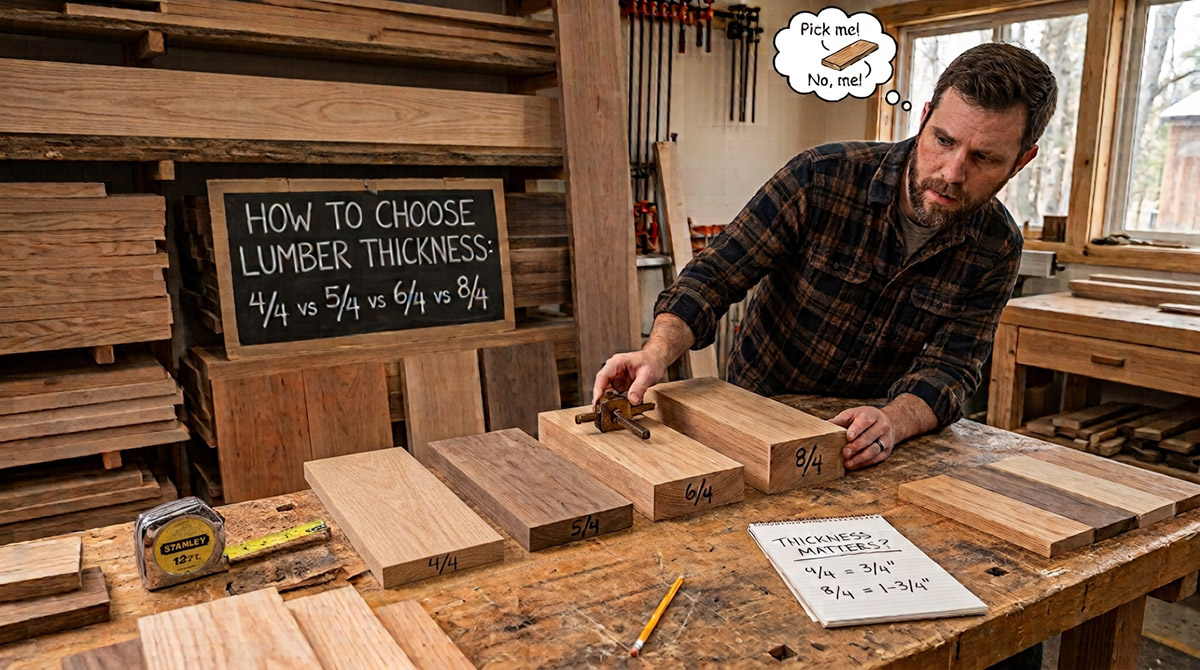
Once you know how to calculate board footage, the next question is usually: what thickness should I actually order? Hardwood is sold in “quarters” — a sizing system that trips up a lot of first-time buyers. Here’s how it works, and how to match the right thickness to your project.
What Does 4/4, 5/4, 6/4, and 8/4 Mean?
- Hardwood thickness is measured in quarters of an inch, based on the rough thickness of the board before it’s surfaced smooth.
- 4/4 (read “four-quarter”) means 4 quarters of an inch, or 1″ rough. 8/4 means 8 quarters, or 2″ rough.
- Once a board is surfaced on four sides (S4S), it loses roughly 1/4″ of thickness to milling — so the finished board is thinner than the nominal size.
- This is standard across the hardwood industry, not just our site, so knowing it will help you read any supplier’s listings correctly.
4/4 — Finishes at About 3/4″ Thick
The most common thickness, and the one most woodworking projects start with.
- Best for: cabinet doors, drawer fronts, box parts, small furniture components, interior millwork, and panels that don’t need extra bulk.
- If you’re building anything with thinner, flat parts — shelving, panels, small boxes — 4/4 is usually your default choice.
5/4 — Finishes at About 1″ Thick
A step up in mass, without jumping all the way to 6/4.
- Best for: stair treads, thicker shelving, tabletops that need more rigidity than 4/4 offers, and mid-weight furniture parts like aprons.
- 5/4 is a good option when 4/4 would flex or feel thin, but a full 6/4 board would be more material than the project calls for.
6/4 — Finishes at About 1-1/4″ Thick
This is where lumber starts feeling substantial in the hand.
- Best for: table legs, chair components, thicker aprons, and furniture joinery that needs more material to cut mortises or tenons into without weakening the piece.
- Many furniture makers keep 6/4 on hand specifically for legs and structural parts, ordering 4/4 separately for the panels and show surfaces.
8/4 — Finishes at About 1-3/4″ Thick
The thickest common option, and the starting point for anything that needs real mass.
- Best for: thick table legs, workbench tops, turning stock for bowls or spindles, and any project where you want a substantial, solid look.
- 8/4 is also the best choice when you plan to resaw a board into two thinner pieces yourself — you’re starting with enough material to end up with usable thickness on both halves.
How to Decide Which Thickness You Need
- Start with your project’s finished dimension, then add back what milling removes — if you need a finished 1″ leg, order 5/4, not 4/4.
- Check your plans or cut list before ordering. Most furniture plans will already specify rough thickness needed for each part.
- When a project mixes parts — like a table with thin panels and thick legs — it’s common to order two different thicknesses rather than milling everything down from the thickest board.
- If you’re unsure, thicker is the safer direction to buy in — see below.
Buying Tip: You Can Always Go Thinner, Not Thicker
A thickness planer or resaw can remove material, but there’s no way to add thickness back to a board that’s too thin for your project. If you’re between two sizes, it’s almost always better to order the thicker option and mill down, rather than order thin and find out mid-project that you’re short.
Shop by Thickness
Browse our full range of S4S lumber by thickness. Popular picks include Red Oak 4/4 and Hard Maple 4/4 for panels and show surfaces, Red Oak 5/4 or Hard Maple 5/4 for tabletops and aprons, Hickory 6/4 for legs and structural parts, and Walnut 8/4 or Hard Maple 8/4 for thick legs, workbenches, and turning stock.